When your democracy is collapsing, why not cook a big complicated Italian feast?
February 7, 2026
Honestly it’s hard to get through the days these days, listening to the news and watching the astonishing video that regular folks have been capturing for months now but which seems to get worse and more violent with each passing day. But even saying you have a problem with masked, unidentified men in camo with long guns barging into hospitals, schools, and churches to snatch people without warrants or due process, gets you into a further problem: some people think this is good.
Well, in the face of that, I got nothing.
Truly. Nothing.
So today we’re cooking.
It is the tradition of our family to watch the Olympic opening ceremonies while eating the cuisine of the region where the Olympics are taking place. Just to name a few, we’ve done fish and chips wrapped in newspaper, a platter of Russian dumplings and carrot salad with Russian tea, Korean beef bowls, and a Paris bistro meal.
I know. I know. But this sort of thing is fun for me.
Honestly, though, I hadn’t cooked a big schmoo in a long time and I wasn’t sure I could do it anymore, even with only three guests. Also my mind is much occupied by other things that crowd out thoughts of entertaining. Well, cooking for loved ones is always calming and centering, always a good excuse to try new recipes and learn new things. So I forged ahead.
One of the most classic dishes from Milan is ossobuco with saffron risotto, so that was what I decided on first. Milan’s wildly diverse food culture has the advantage of being shaped by many different outside influences, whether through proximity or previous rule. And its agriculture shapes its food as well. So up here you see less of the tomato-olive-oil-and-pasta that prevails in southern Italy. Up here you find more butter than olive oil, more red meat than shellfish, and strong Spanish influences as well as Austrian and French. I used a Lidia Bastianich recipe that incorporates lemon and orange peel and also orange juice into the carrot-onion-celery-tomato based sauce. It’s all cooked for a very long time. Lidia wants you to press this sauce through a sieve just prior to serving to remove anything solid that remains, and I, being lazy, do not. So I didn’t.
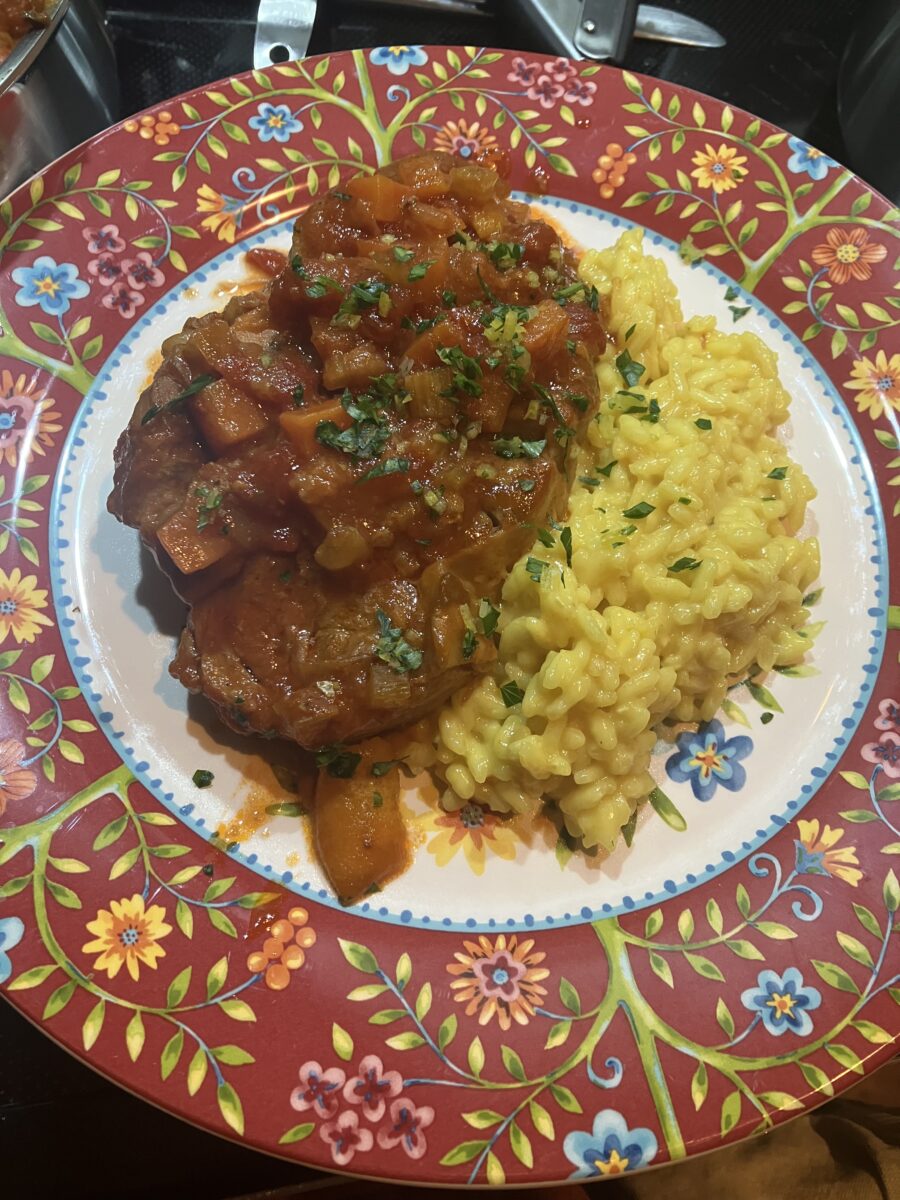
Saffron risotto is one of those dishes that’s so old and entrenched in Milanese culture it’s hard to trace its origins. Some say saffron was first imported here and used in the Middle Ages for creating color in stained glass, then popped into the food as an afterthought. But however it is used it has always been precious. Probably a 14th c. import from Spain, it takes 200 crocus blooms to produce just one gram of saffron. It is still harvested by hand and, in accord with Italian saffron production protocol, then undergoes a drying process over a wood-burning grill. Its production has been an economic boon since the Middle Ages, funding basilicas then and supporting communities today.
ICE is now snatching refugees. Refugees are the most highly vetted of all immigrants to enter the US. It takes years and years. And now they are being yanked out of their communities, taken across country, and thrown into camps. Like they spent probably years in, wherever they came from, already.
In my reading about feasting in Italy I quickly realized that you don’t just “make dinner” and serve one thing at one time in Italy; if I’m going to be authentic I needed to add at least a few more courses. So I decided on an aperitivo, antipasti, insalata, and dolce courses. That’s a five course meal if you’re keeping count. I’ve knocked out the primo, the formaggi e frutta as well as the caffe and the final digestivo capping off the very end, literally aiming to ease the digestion (how could that possibly be necessary?).
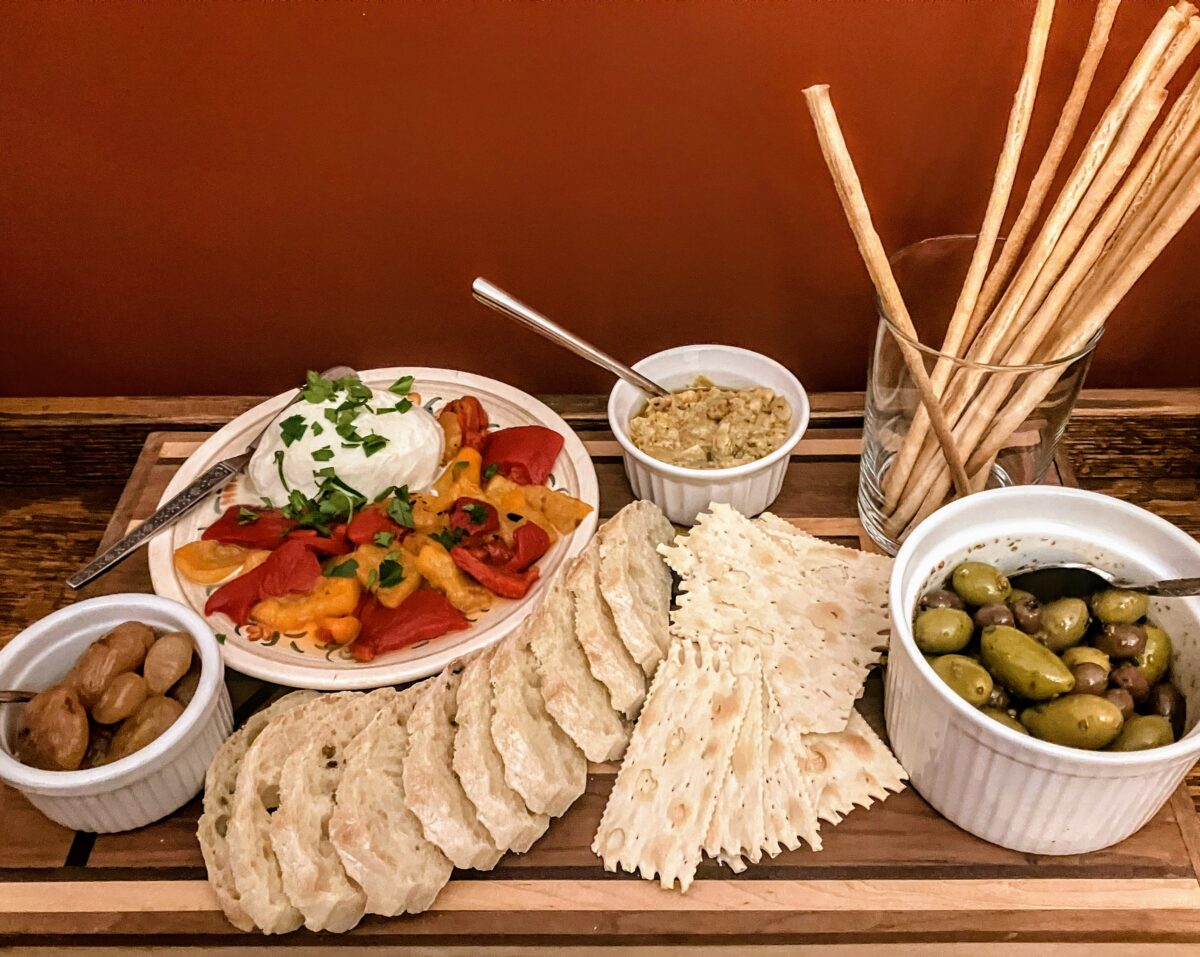
For our aperitivio we mixed up the Hugo Spritz. The other end of the age spectrum from saffron risotto, the Hugo Spritz hails from the Austrian border region and was dreamed up in 2005. A lighter version of an aperol spritz, it’s taken its sweet time to wander to the US and has undergone some regional alterations. Ours is elderflower liqueur, prosecco, seltzer, mint sprigs, and a lemon slice. Delightful! With this (or should’ve been after? I have no idea what’s correct), we shared burrata with roasted red peppers, marinated olives, artichoke bruschetta, and grissini.
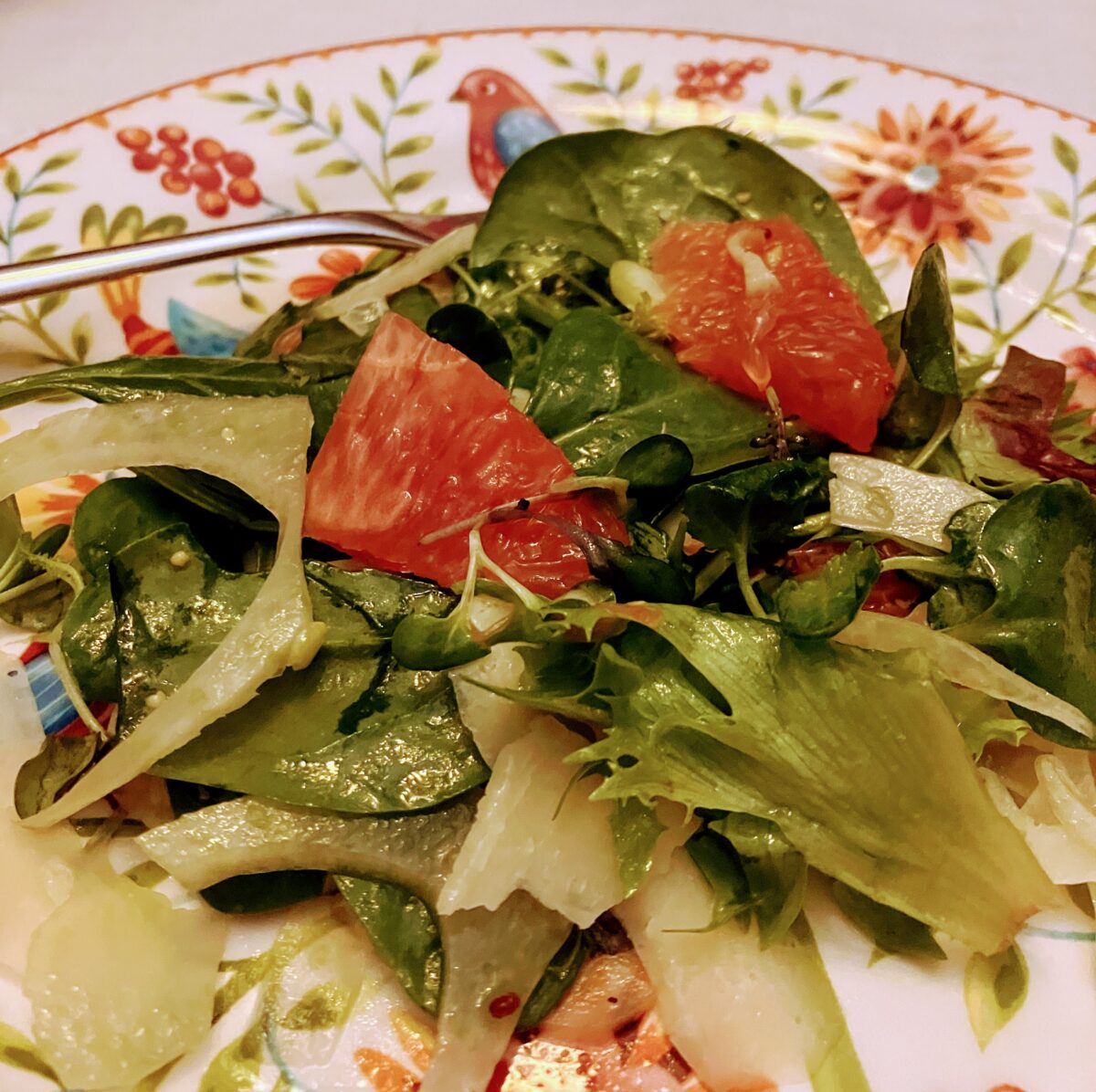
Following our aforementioned ossobuco came a grapefruit and fennel salad, as if we could still eat anything else at all. Citrus is available all winter in Italy as it is in the US, and it was refreshing and snappy after our ossobuco.
And for dessert, affogato, because two little scoops of gelato (Talenti) with a shot of espresso is a heck of a lot easier to make than, say, half a dozen tiny panna cottas nestled into their fastidious water bath, or a tall, fruit-filled panettone–Milan’s own invention. That affogato was maybe my favorite thing of the night, light and cold, the perfect non-overwhelming ending to a grand feast.
On a blustery Chicago night it was a lovely evening with loved ones together around a table, despite bounding dogs and chipped plates. I remembered why I like, sometimes, to cook a big schmoo. Cooking, as always, is centering and distracting, even though new revelations and daily vileness peck at my brain.
That overnight raid on the apartment building in Chicago? The really boss one with the Black Hawk helicopters, zip tied children, and the 300 armed personnel? Happened with the building owner’s blessing, possibly request, probably to forestall dealing with their own legal troubles regarding the desperately unkempt property. Since the raid not one resident has been charged with a crime. Not one gang member has been identified. But everyone’s apartment was trashed and destroyed and the building is now empty of residents and slated for destruction, just as the owner wanted.
Let me tell you, I LOVE the Olympics. I love the Winter Olympics especially. I know the thing I’m supposed to feel, as a frequently progressive person, is that the Olympics ravage cities, stress the environment, and place an unsustainable financial burden on communities and countries. I accept that these things are probably true. But I still have a googly-eyed crush on the Olympics. I was, I think, the only person I know who really really wanted the Olympics to come to Chicago. Right to my neighborhood! And alas–they did not.
Instead, ICE came to my neighborhood. Their presence did harm communities egregiously–everyone feels the burden of terror living under an arbitrary disordered occupation; they impacted the environment with all their tear gas, smoke bombs, car chases, and on-purpose car crashes; and their impact on our economy is ongoing as thousands of people are too afraid to go to jobs, and hundreds of small businesses like restaurants and shops are in danger of shuttering because their customer base is too afraid to leave their homes.
All that and we didn’t even get a stadium that’s too big to use ever again.
Now ICE has headed to Milan. Did you know ICE typically goes to the Olympics? Probably you didn’t. We didn’t used to think about ICE so much. Try to track their every move. They didn’t used to kill citizens and deport veterans and eradicate green cards and fail to honor lawful refugee status, didn’t used to shoot pastors with pepper bullets. They have often been on hand for overseas security assignments. But they’re not welcome in Italy now. The mayor of Milan, Guiseppe Sala, does not want ICE in his city. He put it plainly: “‘This is a militia that kills,’ Sala said in an interview with Italian media. ‘It’s a militia that enters people’s homes by signing permits for themselves.…. [T]hey don’t guarantee they’re aligned with our democratic security management methods,’ Sala said. ‘We can take care of their security ourselves. We don’t need ICE.'” Sala is not the only one who questions ICE at present: “’It is a violent, unprepared, and out-of-control militia,’ Carlo Calenda, a veteran politician, told RTL 102.5 on Tuesday.”
But the Department of Homeland Security, in a curious wording, insists that no ICE officers are members of the US Olympic delegation. Instead they will be working with the US Embassy–ostensibly as they usually do. Their presence, they assure, is trustworthy and typical.
As ICE rolls out the aggressive use of new facial recognition technology in American cities–“setting a new standard of street-level surveillance and information collection that has little precedent in the U.S.”–it gets harder and harder to trust that presence and to see it, any longer, as typical.
Our feast was so long and stretched out we missed the entire opening ceremonies. So I streamed them after everyone left. It was all very Italian with a lot of gray, and I really don’t understand dance, but I swooned over the parade of nations and the lighting of the Olympic flame, as always.
I think my favorite thing was the IOC President’s remarks. A little sleeper of a speech, it absolutely fits in with the tradition of IOC presidents saying obvious and idealistic blah blah blah about humanity. But it just hits different at present.
Kirsty Coventry of Zimbabwe, former Olympic athlete herself, slipped in a lot of beautiful rhetoric that stands in strong contrast to what we hear on the regular from the current administration. “Strength isn’t just about winning. It’s about courage, empathy, and heart.” When was the last time you heard anything like that from Trump? He believes strength is winning; strength is the display of power; strength is violence; strength is domination.
She went on:
“This is why we all love the Olympic Games. Because through you, we see the very best of ourselves. You remind us that we can be brave. That we can be kind. And that we can get back up, no matter how hard we fall. …
“When we see an athlete stumble and find the strength to rise, we are reminded that we can do the same.
“When we see rivals embrace at the end of a finish line, we are reminded that we can choose respect.
“When we see grace, courage and friendship – we remember the kind of people we all want to be.
“The spirit of the Olympic Games is about so much more than sport. It is about us – and what makes us human.
“In Africa, where I’m from, we have a word: ubuntu. It means: I am because we are. That we can only rise by lifting others. That our strength comes from caring for each other.
“No matter where you come from, we all know this spirit – it lives and breathes in every community.
“I see this spirit most clearly at the Olympic Games. Here, athletes from every corner of our world compete fiercely – but also respect, support, and inspire one another. They remind us that we are all connected, that our strength comes from how we treat each other, and that the best of humanity is found in courage, compassion and kindness.”
This is probably why I love the Olympics too.
And that these things–courage, compassion, and kindness–are utterly and completely lacking in the current quota-driven mass deportation project consuming our nation right now? Is why I have trouble with ICE.
And so I pray. And so I write. And so I cook. I hope you do too.
my spirit just lifted immensely, and my heart warmed to find you and this brilliant weaving of sustenance and feasting into the horrors of these times. i wanna come for dinner next time you whip up this multi-course feast.
Oh my goodness I’d love to have you over for a feast, now that I see I can more or less remember how to do it! bam, that I can lift your spirits makes me happy as your wonderful blog has always done the same for me.
I want to come too.
Marvelous essay. I want more of this goodness.
Thanks for your kind words Stacy. I’ll do what I can. 🙂
Thanks for highlighting the IOC president’s speech as we all need some inspiration. And of course loved the meal!
Sometimes a bureaucratic blah blah blah really hits the nail on the head!
Loved having you!
Oh Julie.
Utterly beautiful.
Utterly horrific.
Thank you for pouring all this into words.
I can taste your meal. It warms and satisfies me.
I don’t know what to say about all that is unfolding either.
Lord, see and have mercy.
Bigggg hug and all my love.
Thinking of you always, E! I so appreciate your reading and response. And truly, “Lord, see and have mercy” is really all we can say.
Well cousin, while you were cooking, I was cutting glass. Making something delicious or beautiful or lovely to listen to or cozy to wear… these are things that still make sense in a whirlwind of things that do not. Making is therapy. I find it is usually wrapped up in love and service and kindness. Thanks for your wonderful words at this hard time. Keep making. Keep writing. Keep cooking!
Creating is a very vibrant positive act in a world full of negative destructive forces. Creating anything in love, and for others, is even more powerful. Creating is one way we bear the image of God. I can’t wait to see what your next beautiful made glass thing is. Thanks for reading and stopping by.
YES. Simpatico. And you know I love the Olympics too!
<3
Good piece. Good to read your writing again.
Thanks Joan! (I missed coffee for all this slicing and dicing.)