Surely you too celebrate your Statehood Day?
February 13, 2026
Full disclosure, this is an old essay that I’ve trotted out for several Arizona Statehood Days.
That is, Valentine’s Day. They’re the same. Arizona became a state on February 14, 1912, having suffered some delays in attaining entry to the union because its state constitution was just a titch too progressive. Arizonans were distrustful of concentrated power and wanted to guarantee a few elements intended to maintain their voice and to distance themselves from federal overreach. But two of those provisions were problematic to President Taft at the time. Arizona’s constitution sought to ensure that labor would be protected against federal intervention, and worse still, it insisted on the right to recall elected officials including even judges. Taft, judge that he was, felt this compromised judicial independence and compelled territorial leaders to strike the provision for judicial recall. Arizona was in. (And then they added judicial recall right back into the constitution months later, in November of 1912. Sneaky little buggers, those progressives.)
Isn’t it an amusing little exercise of the historical imagination to contemplate an Arizona that was….too progressive to be let into the US? I think so. But most folks there today still feel the same about overt concentrations of power and of federal overreach. Many of them have been making their voices heard about those very issues in recent weeks, in walkouts of thousands of students and protests at the state capitol against what appears to them to be the lawless violence of ICE and CBP in American cities. (Of course, not all Arizonans agree. Many of them, Christians in particular, now seem to honor and revere concentrated federal power and the abrogation of due process. But that’s a matter of religious freedom and I digress.)
Anyway, at our house we still celebrate Arizona Statehood, albeit with more of a polite acknowledging nod than, shall we say, the whole enchilada. Without further ado, and in the spirit of joyful creativity and banding together with your friends and neighbors to celebrate just any old thing at all, here is that story of Statehood Day, including several truly wonderful recipes appended below.
By the way I highly recommend banding together and celebrating just any old thing at all, even in–especially in–dark times. In this era when our constitutional rights are being shredded, neighborliness and joy are two things that can never be taken away.

It started with a newspaper clipping my mother sent to me from Arizona, a recipe for a cake that was supposed to look like a barrel cactus.
She thought it would amuse me, and it did, enough to create a little party around it. The cake was green, covered with what looked exactly like cactus spines (who wouldn’t think that was yummy?) and had an artful sugar cactus blossom on top. The recipe arrived in February, the most miserable and, incongruently, the longest month of a Chicago winter.
Just in time, I was happy to note, to conjure up a celebration of Arizona Statehood Day.
This is not, I must confess at this juncture, necessarily an actual observed holiday in Arizona. We had never once celebrated it in my entire third-generation, Tucson-born, Phoenix-raised Arizona life. But in my Chicago life as a graduate student in a house full of roommates, I never said it was, I never said it wasn’t. I might have implied there were rodeos involved, or bank closures. No one else even knew their statehood day and they were more than willing to go along with mine. Why not eat Southwestern food and celebrate the desert in the darkest, dreariest part of the winter? That first Statehood Day it was just me and the roommates, and the cactus cake.
They helped me make it. Who could possibly withstand the temptation, the challenge, to pipe hundreds of tiny royal icing cactus spines, as thin as string and a 1/2” long? While the cake—chocolate with distracting flavorings of coffee and almond—baked in a bowl, we piped. And piped. And piped.
I thought this was time consuming but truly, we had not even gotten to the utterly prodigal, flamboyantly idiotic part of the process. After frosting the cake in a green buttercream that went a bit beyond cactus, we began to place the tiny spines (“they go in columns! Put them in little clusters in columns!” I barked to little avail, “the clusters must be no more than a 1/2” apart!”). When we were finished, this cake looked less like a barrel cactus than a hedgehog or a giant miscolored Hostess Sno-ball. And when I adorned the top with a fuschia blossom, it took on the look of a great spiky alien breast. It was clear that after many satisfying hours avoiding school work with my roommates, we had an entirely unappetizing cake to show for it.
So I donned my mother’s turquoise 1950’s squaw dress, a full-skirted, very incorrect sorority party number covered with silver ric-rac. The dress seemed to match the whimsy of the cake, and became, with my cowboy boots, the uniform of Statehood Day–from that day all the way to the time when I could no longer zip up the skirt, 15 years and two babies later. The cake, I must hasten to add, never made another appearance.
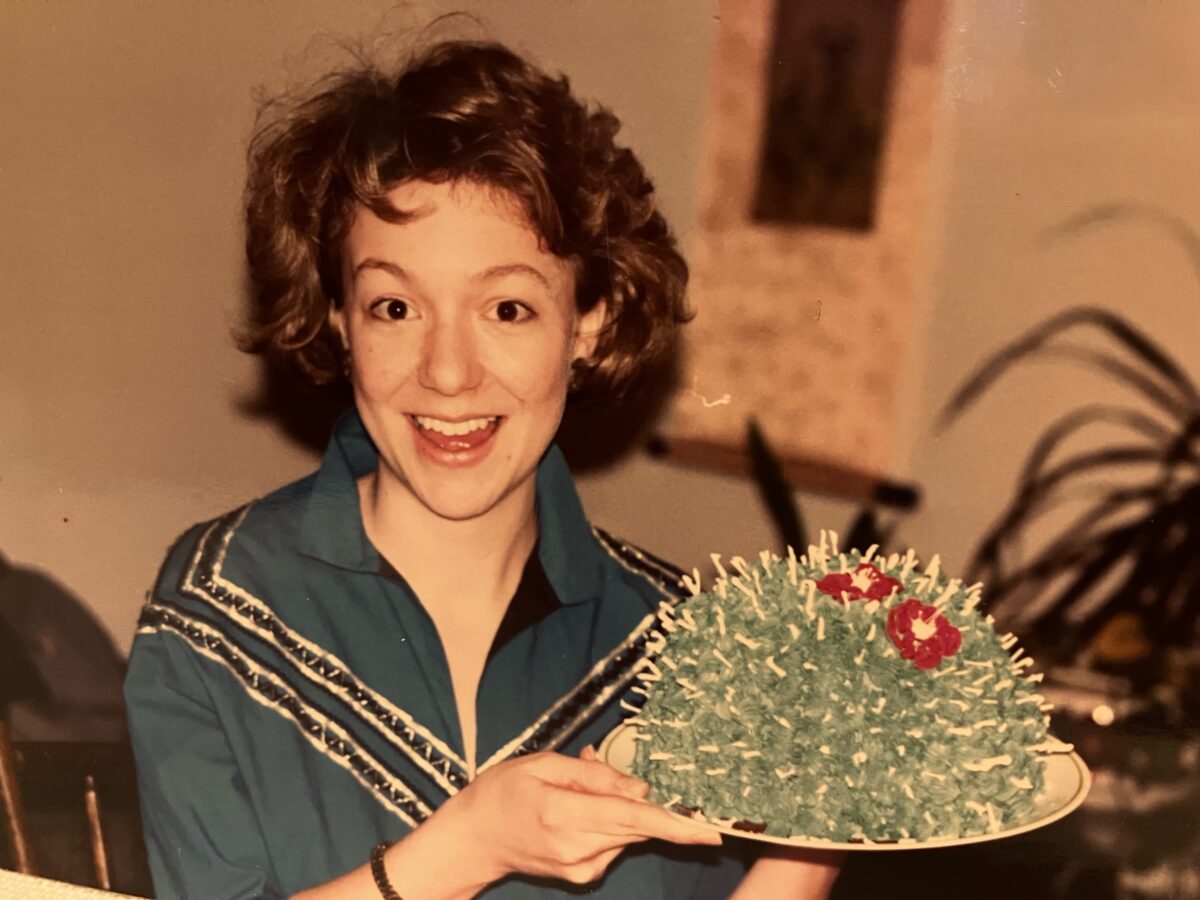
How do these things happen? How does one festive foolish dinner turn into a decades-enduring, bloated, annual event of staggering effort?
Who knows. There were a few factors. It sort of picked up slowly at first, a guest for dinner, maybe two, some new dish attempted to honor my desert Southwest. Probably the date itself had much to do with the loyalty it engendered among Statehood Day observers. Here we were, wandering matelessly through our twenties and beyond, in an environment somewhat unlikely to produce Valentine sweethearts. We were grateful to have the party to distract, delight, and exhaust us on that dreadful day.
What really kicked things into a higher gear was the arrival of a second displaced person from Arizona, our roommate Christine. She was from Tucson, and like me loved all things desert. She was most receptive to becoming a chief co-conspirator for the event. Christine knew how to do things I did not, such as make tortillas, and had patience to do things I would not, such as refry her own beans from dried, and roast and peel fresh chiles. I built on basics like my uncle’s recipe for green chile, a pork and beef burro filling with chopped green chiles from a can. I found a reliable recipe for a lovely molé that did not require roasting and grinding my own nuts and seeds.
Every year, early in January, Christine and I would sit down, an array of cookbooks before us, and choose a soup, a salad, five or six entrees, three or four sides in addition to the tortillas and beans, and debate over the necessity of confronting our dangerously stuffed guests with dessert (which usually turned out to be my Grandmother Randall’s Ginger Cookies). We focused mainly on Sonoran recipes and veered occasionally into New Mexican or Baja Peninsula territory. We tried every possible color of sangria. Sometimes special ingredients had to be ordered from neighborhood stores, like the dried juniper berries I persuaded my produce market to get for me–I needed 6 of them for a Hopi-style lamb-hominy stew, and the rest of the jar of berries sat on the store’s counter for several years after that.
We always made trips to the Mexican grocery stores on west 55th Street for things like piloncillo sugar and certain kinds of dried chiles and true Mexican cheeses. Our preparations took weeks.
Certain dishes had to make an annual appearance, we loved them so much, like a creamy rice and poblano casserole. Others were so difficult to make just right on a large scale, like fish tacos, that we only trotted them out a couple of times.
Because the scale was becoming large indeed. As our guest list grew, we faced the same question every year. How do you make a dinner party for morally energetic eaters of every imaginable stripe? Our neighborhood was nothing if not morally energetic. Well, you just have to make a lot of different dishes. We wanted to make sure every guest could put together an entire meal, regardless of dietary constraints. We fed vegetarians and vegans. Gluten free. Dairy free. Low carb. I internally bristled at the requirements of the free-range-chicken-only eaters, and I crumpled in defeat in the face of guests who kept kosher.
Somewhere in these years my co-conspirator’s boyfriend was added to the mix, and he went whole hog with the theme, toting in chile-pepper light strings, a giant blow up saguaro cactus, larger than life decorations. Somewhere in these years I turned up my own sweetheart, who was always a bit flummoxed by the day (“…Am I supposed to give her flowers? Candy? A cactus arrangement? What?”). We always played old Arizona cowboy crooners like Marty Robbins and Rex Allen, and mariachi music. Guests stayed till midnight or one in the morning, long eclipsing my capability to fête my state’s entry into the union.
And by that February when I was seven months pregnant with my second child, staggering along in my boots which now had holes in the toes, picking up the detritus of a feast while happy guests sat, gregarious and laughing, I was through, absolutely through. Arizona had been celebrated sufficiently, I decided. By then the party had followed me through three homes and into my marriage; several generations of PhD students had come and gone; we were now feeding everyone’s children and I was starting to feel obliged to come up with children’s activities. What was next, a bounce house? No. This had to come to an end. And so Statehood Day disappeared, just like that.
Oh, sure, every few years my friend Christine and I exchange an email, think about rolling out the whole apparatus again. We think about it. We long for creamy rice with poblanos. We get together and pull out the cookbooks. One of us looks at the other with a raised eyebrow. Then we decide to cook for each other and leave it at that.

Statehood Day Recipes
Jim’s Green Chile
This burro filling, a recipe from my aunt, is easy and delicious but takes some time. You must stir it frequently during cooking to prevent sticking. I am printing the recipe as written by my aunt, although I haven’t been able to find the called-for Ortega products for some years. I substitute with the closest things I can find.
1 chuck roast, 2 to 3 lbs.
1 pork roast, 2 to 3 lbs.
3 T. flour
3 cloves garlic, minced
3 large onions, diced
Cumin, salt, pepper, oregano, to taste, maybe 1 t of each to start
2 6-oz. cans chopped green chiles
2 8-oz. cans Ortega taco sauce
2 8-oz. cans Ortega green chile salsa
2 c. water
2 T. lemon juice
Cube meat and discard fat and gristle. Coat with flour and then brown slowly and thoroughly with onions, garlic, and seasonings. Use a heavy-bottomed pot to prevent scorching. Add canned ingredients, water, and lemon juice. Simmer several hours (2 to 4) until meat can be shredded with forks and liquid has thickened, stirring occasionally. Makes about 20 burros. Freezes well.
Carlos’ Chicken Molé
This is adapted from a recipe by legendary Native American flutist R. Carlos Nakai, which first appeared in the 1985 Guild cookbook of Phoenix’s Heard Museum, From Metate to Microwave. It has been a favorite of mine ever since. Over the years I have made a few alterations for ease of preparation. Sometimes I will buy a roasted chicken from the grocery store for this and add the cilantro and sauteed garlic and onions to the sauce later.
1 whole chicken
1/4 c. chopped fresh cilantro
6 cloves garlic, diced
1 large onion, diced
1/4 t. black pepper
2 oz. Mexican chocolate
2 8-oz. cans tomato sauce
2 heaping T. peanut butter
2 heaping T. sesame tahini
1 t. cumin
1 t. good New Mexican chili powder
1/4 t. cinnamon
2 c. chicken broth
Pressure cook chicken with cilantro, garlic, onion, and black pepper in 3 c. water. Save broth, cool chicken. Debone chicken and shred or chop into small pieces. Melt chocolate in a bit of broth in a large pot. Add tomato sauce, peanut butter, tahini, cumin, chili powder, and cinnamon and simmer for 20 minutes. Stir in 1 c. chicken broth and add chicken pieces. Add salt to taste, or use lime juice instead of salt. If sauce is too thin make a thickener out of remaining chicken broth and a 1/2 c. of masa harina. Serve with warm corn tortillas.
Hopi-Style Lamb Hominy Stew
From New Southwestern Cooking by Carolyn Dille and Susan Belsinger (Macmillan, 1986), a Sonoran-leaning compilation full of can’t-fail recipes. This is very traditional and not at all “new.” I think juniper berries are easier to find now than they were when I first made this.
4 lbs bone-in lamb shoulder
6 quarts water
1 onion, peeled and quartered
6 juniper berries
2 garlic cloves, peeled
1 t salt
½ t whole black peppercorns
1 large fresh sage sprig or ½ dried sage
1 26-oz can hominy, drained and rinsed
½ c finely diced onion for garnish
¼ to ½ c finely diced fresh poblanos
Trim the lamb and put it in a large stock pot. Cover with water by 4 inches.
Bring to a boil, skim surface, then reduce heat to a medium simmer, and skim frequently. Add water to keep the level about 3 inches above the meat. Simmer for an hour.
Add onion, juniper, garlic, peppercorns, and sage to pot. Simmer for another hour, skimming occasionally.
Strain the broth through a colander lined with a cheesecloth into a clean pot. Pick the vegetables, herbs, and spices off the meat and return the meat to the broth. Add hominy and simmer, covered, for 30 minutes. Serve hot and pass the garnishes at the table. Serve with warm tortillas or bread.
Creamy Rice with Poblanos
This recipe comes from a wonderful book called Food From my Heart: Cuisines of Mexico Remembered and Reimagined (Macmillan, 1992) by Zarela Martinez, a Mexican chef from the Sonora region who ran a successful restaurant in New York.
4 c. water
1 T. butter
2 t. salt, or to taste
2 c. converted rice (yes, really)
2 T. vegetable oil
1 small onion, chopped (about 1/2 c.)
1 garlic clove, minced
2 poblano chiles, roasted, peeled, seeded, and diced
2 c. fresh or frozen (thawed) corn kernels
1 1/2 c. Crema Agria Preparada [note below]
2 c. shredded white cheddar cheese
Bring the water to a boil in a medium sized saucepan, add butter and salt. When butter is melted, add rice and bring back to a boil. Reduce the heat to very low, cover the pan tightly, and cook for 20 minutes. Allow to cool in the pan uncovered. Preheat the oven to 350 degrees (325 degrees for a Pyrex dish). Heat the oil in a heavy skillet over medium heat and add onion and garlic. Cook, stirring, until wilted, 2 to 3 minutes. Add poblanos and cook, stirring, for another minute. Let cool then combine with the rice. Mix in the corn, sour cream mixture, and shredded cheese. Pack into a casserole dish, 9 X 9 or 7 X 11, and bake for 30 minutes. Serves 6.
Crema Agria Preparada: mix 1 1/2 c. sour cream with 1 small onion, very finely diced, 1 garlic clove, minced, and 2 T finely chopped fresh cilantro leaves, adding salt to taste. Let rest 5 minutes to blend flavors before using.
Calabacitas
Homey comfort food, this classic Mexican sautéed squash side dish is from the very beautiful Southwest The Beautiful cookbook by Barbara Pool Fenzl (HarperCollins, 1994). My mother sent me this oversized coffee-table volume as a gift when I was in grad school, and its astonishing photos of what I have taken to calling The Blessed Homeland are so gorgeous they made me cry. The recipes are uniformly outstanding.
¼ c. butter
½ c. chopped onion
1 garlic clove, minced
6 c. mixed zucchini and yellow squash, halved and sliced in ½” slices (remove seeds if very seedy)
1 red bell pepper, cored, seeded, and diced
½ c. roasted, cored, seeded, peeled, and diced Anaheim chiles (I won’t tell anyone if you use canned diced green chiles)
1 c. fresh corn kernels (or frozen)
1 t. seasoning mix [note below]
Pepper to taste
1 c. crumbled queso fresco, a lovely mild Mexican cheese; if you don’t have access to that, a cup of shredded Monterey Jack cheese will do very nicely
In a large skillet, melt the butter over medium heat, add onion and garlic and sauté for 2 minutes. Add zucchini and yellow squash and red pepper and cook for another 2 minutes. Stir in chiles, corn, and seasonings. Cover, lower heat, and simmer until squash is tender, at least another 5 minutes. Uncover, sprinkle with cheese and stir over heat until cheese is melted.
Seasoning mix
Mix together and store in a cool dry place:
1 T chile powder
1 T paprika
1 t cumin
1 t coriander
1 t sugar
1 t salt
½ t fresh ground pepper
½ t cayenne pepper
Tangerine Jicama salad
Another recipe from Southwest the Beautiful, this gorgeous mix makes a very refreshing salad. Olive oil is infrequently used in Mexican cooking, but here I swap the corn oil out for olive. Yes, it has a flavor where corn oil does not but I count this a good thing in all instances.
Whisk together, slowly adding oil in last:
¼ c red wine vinegar
3 T honey
1 ¼ t chili powder
½ t crushed aniseed
¼ t cayenne pepper
7 T olive oil
Salt and pepper to taste
Mix together the salad and toss this with as much dressing as you like:
1 small head romaine
1 head curly endive
1 small head red leaf lettuce
4 tangerines or clementines, peeled and divided into segments
1 avocado, peeled and diced
1 c peeled, chopped jicama, however you like it: matchstick, diced, grated
2 green onions, chopped fine
Haven’t we now lived in Illinois long enough to start celebrating its entry into the union?!
LOL, yes!! I just looked it up–Illinois entered the Union on December 3, 1818. Time to plan a party. Not so sure what to serve??
have loved this one every time!!!
LOL it always makes me happy, and then relieved! Thanks for stopping by!