Greek Easter in a box
April 6, 2026

Happy Easter Monday to those who celebrated! I hope you had a joyful day. It is not Orthodox Easter yet; we mark the day one week after everybody else this year.
Somehow, resurrection, the defeat of death, and the subversion of imperial power all seem so timely this year, more necessary than ever; the celebration of two Easters in a row is welcome, is practically mandatory to me. I say this even as I long for the day when Christians east and west celebrate this feast together.
This essay is very old; I wrote it when my kids were little and initially posted it on the now defunct Tribune blog platform, ChicagoNow, in my blog “Cook’s County: Urban Stories of Food and Life.”
Some of the things mentioned in the story, like the Greek chocolatier Govatos Chocolates of Delaware, aren’t around any more. And the church I attend now shares a potluck, instead of going to a restaurant, at 2 a.m. after the Pascha service. And I have changed my opinions on making red eggs with onion skins-–it can work if you use gobs of onion skins. You’ll get a very warm, brownish golden red. Which is beautiful. Me, I like pure bright fire engine red, and when I haven’t been able to get the crazy powdered Greek dye, then an entire large-sized bottle of McCormick liquid red food color does a brilliant job.
What hasn’t changed is how much a huge to-do Holy Week and Pascha are for the Orthodox, how much joyful anticipation and fretting one experiences over services and menu planning alike, and how much love there is in gathering the family together. If you celebrate Easter in either hemisphere, I hope it’s a blessed day full of grace and joy, and that the love of God leaves you dizzy.

I’m awaiting an important box from my mother-in-law. She sends us Easter every year, or at least as much of it as you can fit in a box.
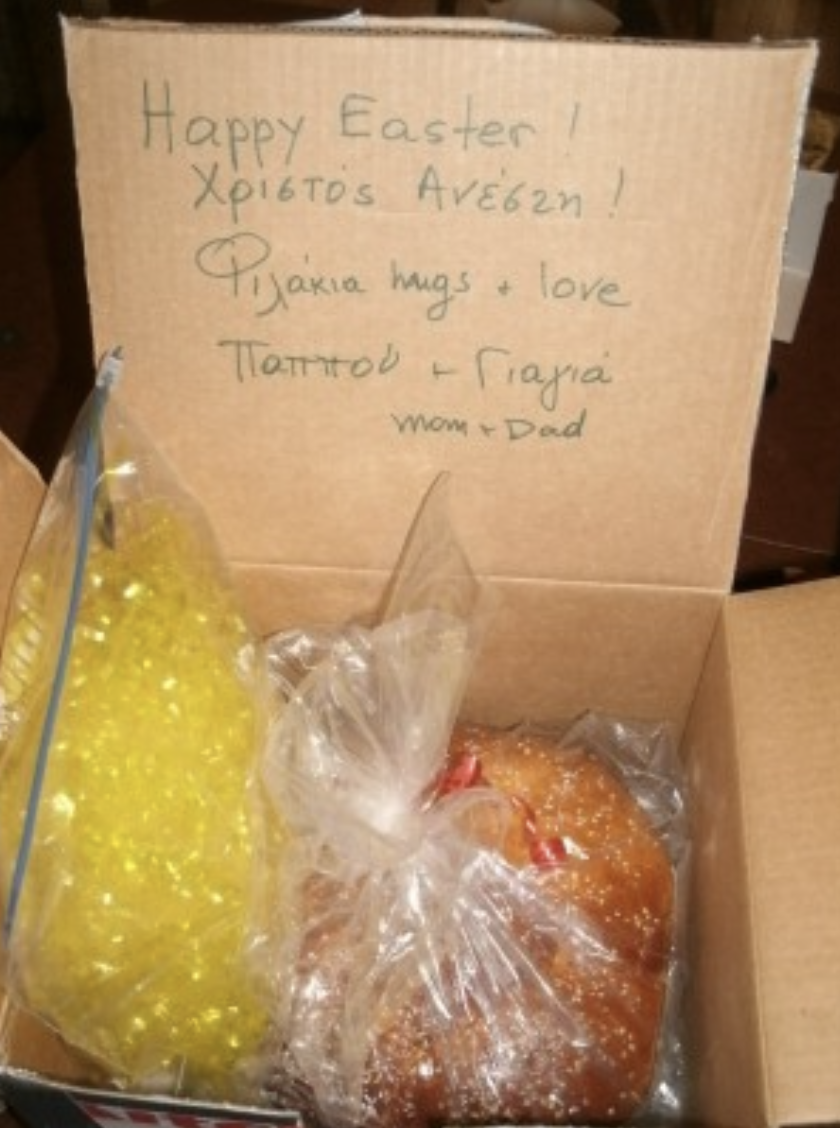
It has not been our Easter yet. Orthodox Easter falls after Passover, so we celebrate this coming Sunday. In addition to our Holy Week services, our Easter box gets us ready.
One critical component of the box is the red egg dye. The Orthodox make only red Easter eggs. You have to use Greek red egg dye or else it doesn’t work. All over the internet are gorgeous photos of red eggs with captions like, “These eggs get their color from beets,” or, “This glorious red tone is achieved using onion skins.”
Don’t buy it! It’s not true! I’m all for being natural and all that. But facts are facts. And natural just doesn’t cut it here.
A glorious red egg may only be achieved using imported powdered red egg dye from Greece. I don’t know why. But no U.S. commercial dye or natural method will produce the proper red egg. I think perhaps the ingredients used in Greek egg dye are illegal in the U.S., but I ask no questions, don my rubber gloves, and get out my worst pot, because everything you use in the process will also become a glorious red. And it’s a sort of permanent color. Stick with the gloves.
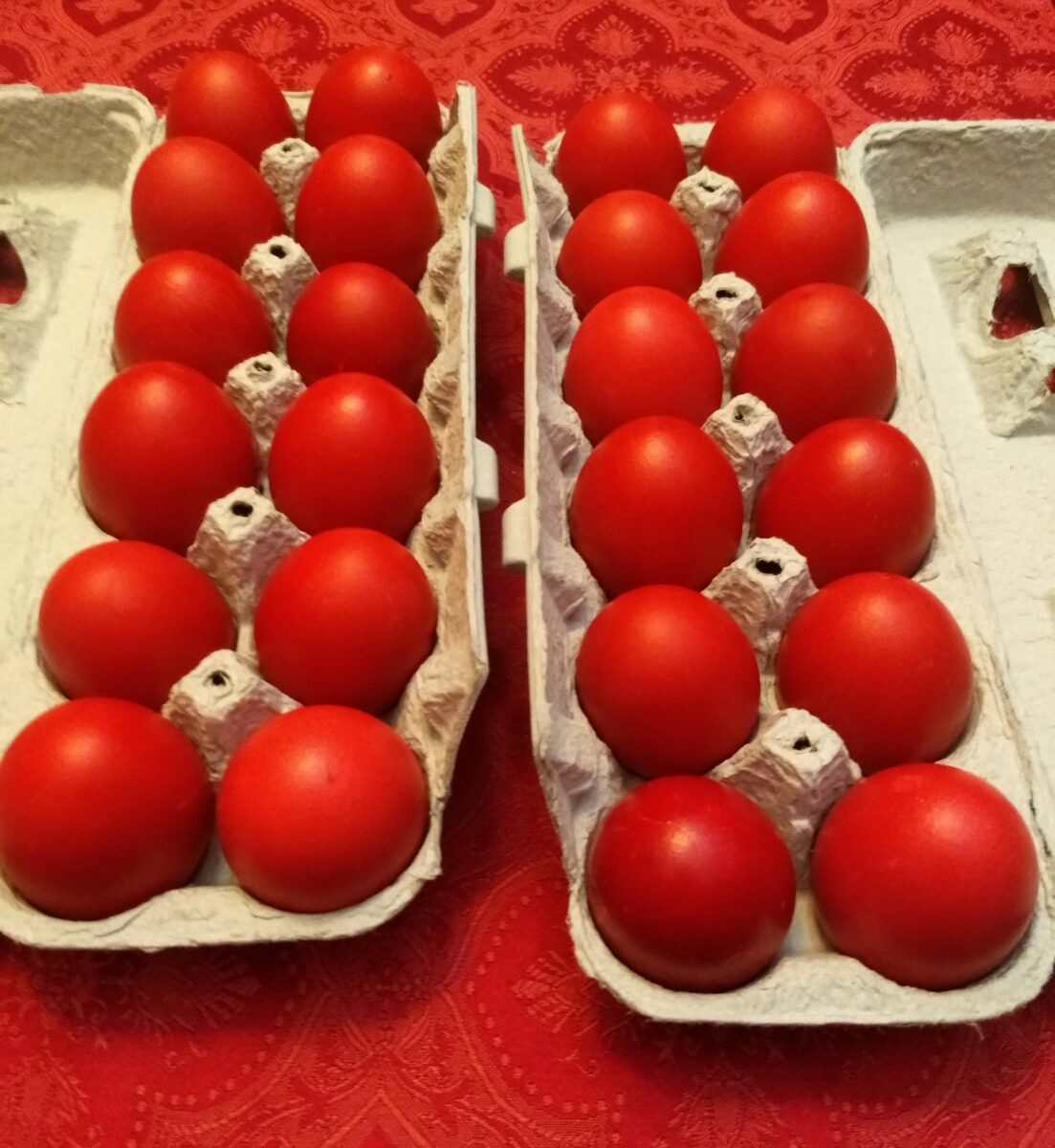
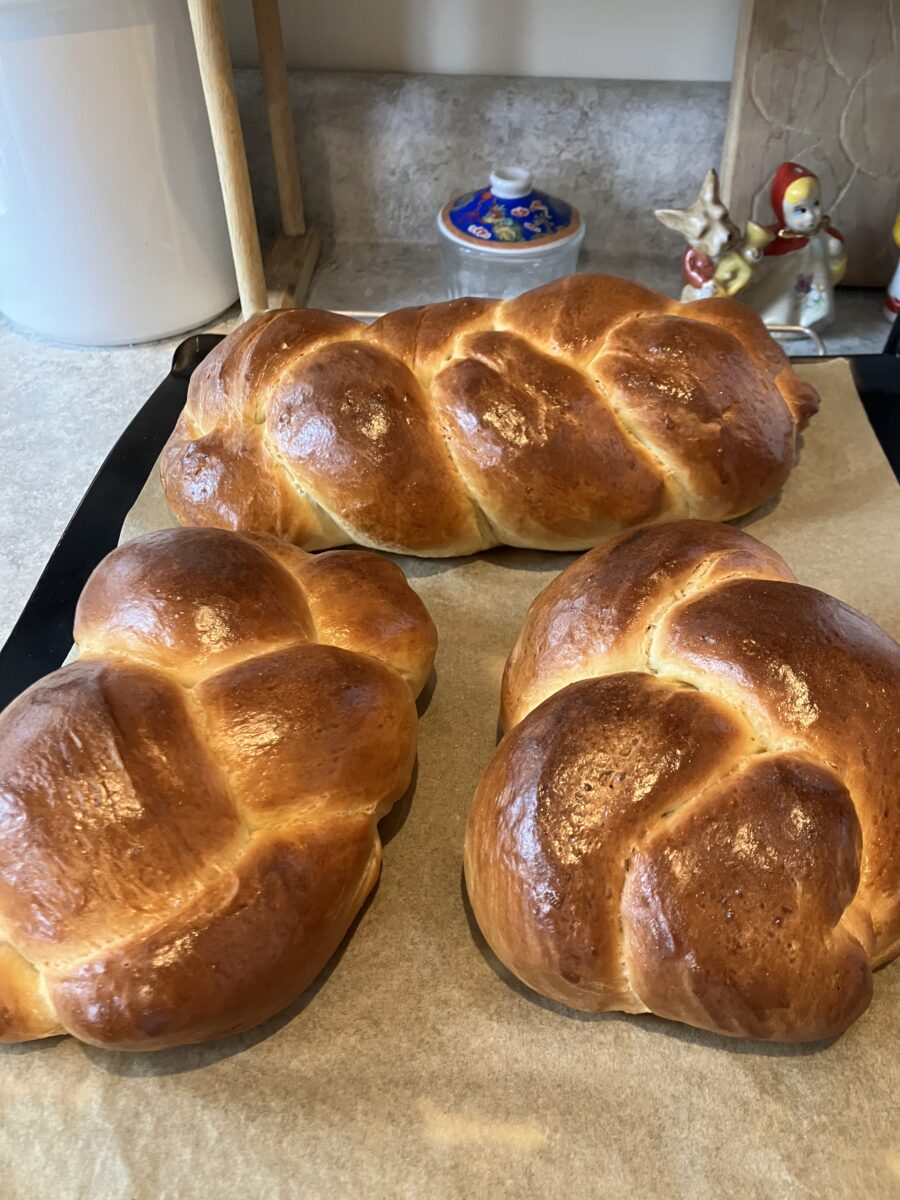
We dye eggs on Holy Thursday. Holy Thursday turns out to be kind of a long day, because in addition to egg dyeing, one also should be baking tsoureki, or Easter bread, that day. Tsoureki is an egg-dense sweet bread that is braided and fixed with a red egg at one end of the loaf. I usually skip the red egg part because I can’t imagine what happens to a hard boiled egg after it’s baked for an hour. I always worry it will explode in my oven. Even though my mother-in-law sends me a beautiful tsoureki in the box, too, every year we still bake tsoureki on Holy Thursday around here because it’s fun to braid bread dough, and the neighbors like them.
So on Holy Thursday after your eggs and your tsoureki, you’ve barely gotten started. That’s because of the Holy Thursday service that begins around 7 p.m., and which is likely the longest of any Orthodox service of the entire year. It’s called the Service of the Twelve Gospels on account of the reading of the entire New Testament’s entire narration of the passion story in twelve segments. The first time I went to this service was my first experience of Orthodoxy. It was in a Greek church and the 12 Gospels were read entirely in Greek. In an Orthodox church, one stands when one listens to the Gospel being read, so trust me, you’re standing a long, long time. My husband and I still look at each other wonderingly, when we consider this, that I ever joined the Orthodox church.
Don’t get me wrong–it’s a gorgeous experience. It’s just quite a lot for a newcomer or the unsuspecting. You need to be in the right frame of mind. You have to step off your mental hamster-wheel of to-do lists and worries and plans. And you need to step into a place where the passage of time doesn’t have a lot of meaning, and just listen, just absorb, quietly, for several hours. (Hopefully, you won’t be plotting out the rest of your Easter feast.)
Now my mother-in-law does not send spanakopita in the box, although that’s an essential part of an Easter feast to my mind. She has tried to give me her recipe, to teach me how she does what she does. Somehow it has never taken. I cannot, for the life of me, make my mother-in-law’s spinach pie in a way that tastes as good as hers. So I’ve had to strike out on my own and find a different course.
If one is striking out on one’s own to learn Greek cooking, one can do worse than land at the feet of Diane Kochilas, noted Greek cookbook author and journalist. Her book The Food and Wine of Greece will set you up with whatever you need to know. Most of her recipes are quite long and involved, and will take tons of time, but the book will reward all your efforts with quite reliably delicious results. (Plus it’s full of delightful unexpected surprises, as my son found out when he paged through it looking for a Greek recipe for a school project. He found a recipe calling for live eel which began this way: “First, kill and clean the eel: Give it a sharp blow to the head, then tie a noose around the eel’s neck….” And so on. I’ll spare you the details on how to clean it properly, but trust me, the kids in my son’s third grade class were riveted.) In addition to fresh spinach Kochilas uses fresh fennel, dill, leeks, and parsley for a very gardeny sort of dish. I’m getting ready to make not just a double recipe of Diane’s spanakopita, but a quadruple recipe. That’s going to be hours and hours of steam-sautéing spinach. It’s a once-a-year, epic sort of preparation, and this week I have time, so I don’t mind.
I’m bringing this spanakopita to my cousin’s house this year for a Big Fat Greek Easter. I won’t be doing the lamb (always done with lemon, olive oil, garlic, and oregano, whether whole on a spit, or tied up in a boneless roast). I won’t be doing the potatoes (peeled and quartered, olive oiled and salted, and popped into the roasting pan with the lamb).
But I will be bringing the non-traditional 3-D bunny cake, chocolate dusted with powdered sugar. He will be a hit with the small set, but he will not taste as good to me as my favorite Easter dessert, rizogalo, or rice pudding, which I may also bring. (Whether I bring it or not is sort of beside the point. I will make it because it is something I make once a year just for this occasion, and if I leave it at home I will probably eat the whole thing myself. Going without dairy for 40 days does this to me.) Not too sweet, flavored with cinnamon and lemon, a good Greek rizogalo is as close to perfect comfort food as you will ever find. But just to make it clear, it is a traditional Easter dessert only for me; Greeks don’t typically eat this for Easter.
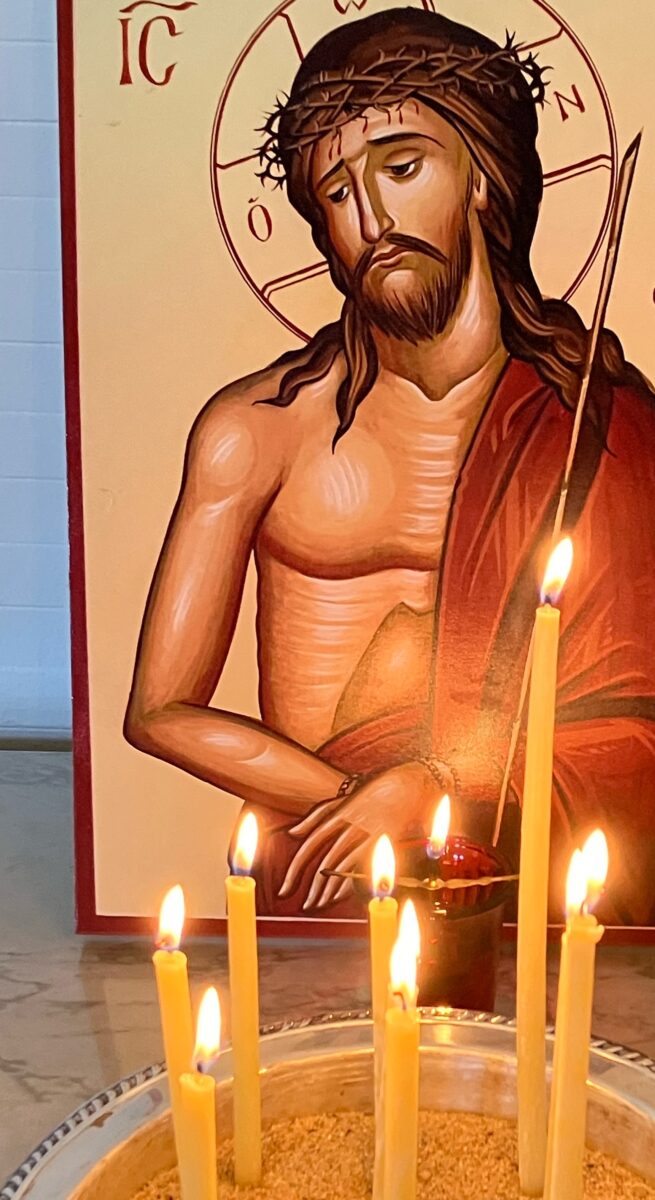
Holy Friday is not a day of cooking and preparation. Friday sees the services which commemorate the trial, death, and burial of Jesus, including a procession around the church on what is decidedly not most people’s Good Friday. Saturday morning’s service celebrates Jesus’ descent into hell and defeat of death; the priests’ vestments are changed from black to white, bay leaves and flower petals are sprinkled throughout the church as the period of mourning comes to an end and anticipation rises for the celebration of the Resurrection.
And that evening, in the dead of night really, comes the service you might have visited if you know anyone Greek–the Resurrection Service.
At our church we will arrive at 10 p.m., spend some time in total darkness, process around the church with candles, sing “Christ is Risen” outdoors about a million times in several languages, and go back inside to continue a happy exhausted worship for another hour or so. Small children will doze on the floor on little heaps of coats. Candles, still lit, will be held carefully so as not to light one’s neighbor’s hair on fire. And as is the case each year according to custom, the priest will read the ancient Easter sermon of St. John Chrysostom, which really is that good. Afterwards we will break our fast at a nearby restaurant that is wacky enough to host us from about 2 a.m. to 4 a.m.
All of this won’t fit in a box.
It is something which busts out of all confines, a span of days which must be experienced, withstood, embraced, drunk up, and swallowed.
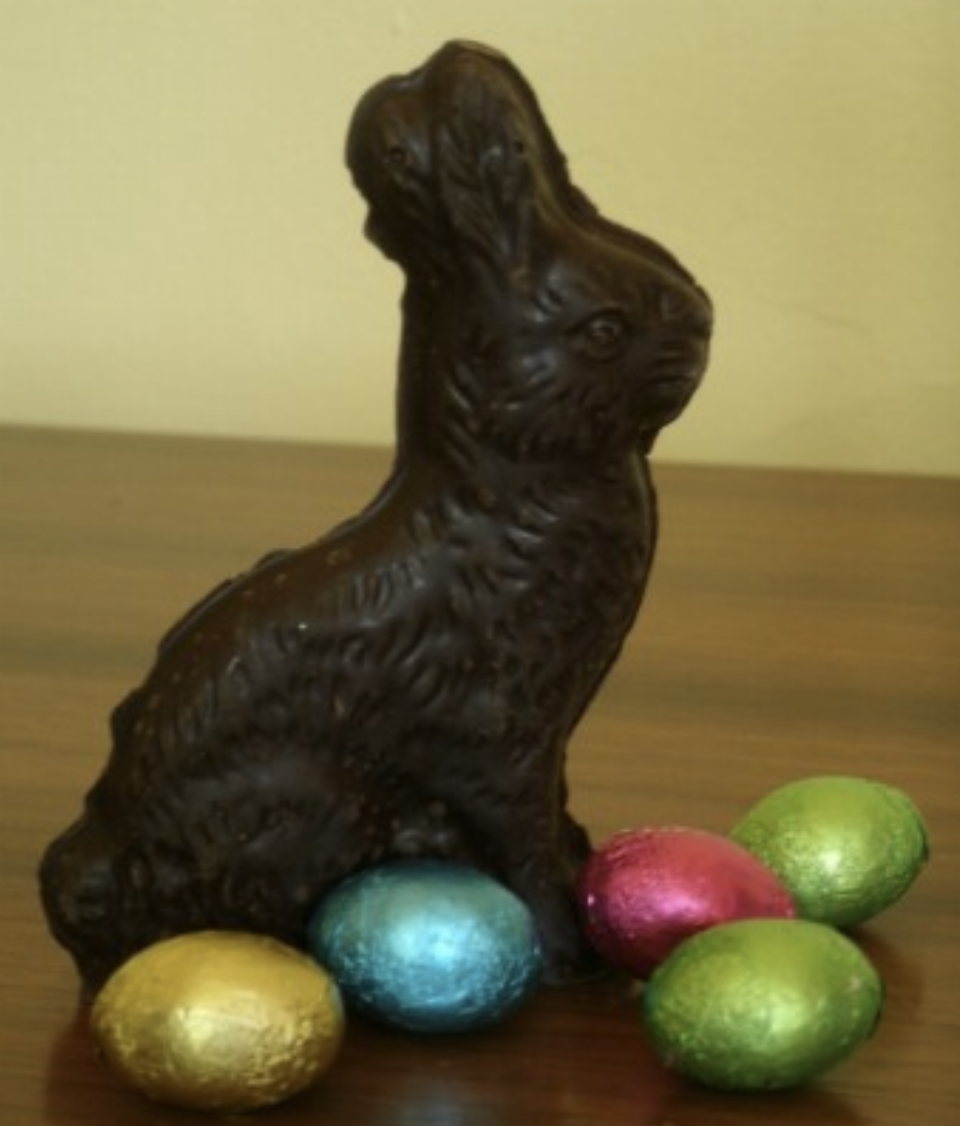
When we wake up the next morning, feeling something like a hangover, we go groggily to Easter baskets, and find in them one more bit of Easter from the box, gorgeous dark chocolate bunnies from the Greek chocolatier near my in-laws’ home, and homemade koulourakia, Greek cookies which my mother-in-law shapes into Greek letters for each person’s name. The box may not be able to contain Easter, but it goes as far as it can, brimming with warmth and love.

Greek Easter Recipes
Tsoureki (Greek Easter Bread)
Spanakopita (Spinach Pie)
Tsoureki
This recipe is from Saveur magazine’s March 1997 feature story on Greek Easter by Diane Kochilas. It makes a quite soft, dense, lemony-orangey loaf that is wonderful plain and possibly better toasted, with butter. The ingredient makhlepi, Mediterranean wild cherry seeds, can be found in Greek stores. It is optional here, and in fact I’ve only used it once. Allow about 6 hours to make this from start to finish. Resist the temptation to use your KitchenAid for the kneading of this bread–the milk and eggs in it mean that hand-kneading is called for if you don’t want a chewy tough loaf. I did learn this from personal experience.
2 7-gram packets active dry yeast
2 c warm milk
9-10 c flour
1 1/2 c sugar
2 t makhlepi (optional)
8 T butter, melted and cooled
6 eggs, 5 for the bread dough and one to brush onto the braids before baking
2 t salt
1 T grated orange zest [grate these before you begin and keep them in the fridge till it’s time to use them]
1 T grated lemon zest
2 hard cooked red eggs (optional)
1. Dissolve yeast in milk in a large bowl. [Follow package guidelines regarding milk temperature religiously and use a thermometer to ensure your temperature is correct!] Stir in one cup flour and 1/2 cup sugar, cover bowl with plastic wrap, and set aside for 1 hour. [I have learned it is best in this hour to melt your butter, zest your citrus, whisk your dry ingredients together, and lightly beat the 5 eggs so everything is ready to go in at the right time.]
Steep makhlepi seeds, if using, in 1/2 cup simmering water for about 5 minutes. Strain, discard seeds, and set aside liquid to cool.
2. Stir 1/2 cup water or makhlepi-scented liquid into yeast mixture. Add butter and 5 eggs and mix thoroughly. Sift 8 cups flour, salt, and remaining sugar into mixture and stir. Add orange and lemon zests, and mix thoroughly with a wooden spoon. Turn the dough out onto a floured surface. Knead (adding more flour as necessary) until smooth, about 10 minutes, then form a ball and place in a lightly greased bowl. Cover with a clean dish towel and set aside to rise for 2 hours.
3. Return dough to floured surface. [The recipe states you should now divide this dough into 6 equal parts, which will make two braided loaves of three strands each. I found that the two ensuing loaves are absolutely enormous. Like, barely fit in my oven enormous. So I make three medium loaves or even four small loaves. Okay, back to the actual recipe.] With your divided dough, roll each portion into a rope about 12″ long for smaller loaves and 15″ long for two larger loaves. For each loaf, tightly braid 3 ropes, then press one dyed egg (if using) near the end of each braid. Set bread aside to rise again for 1 hour on a lightly greased cookie sheet.
4. Preheat oven to 350 degrees. Brush bread with remaining beaten egg, and bake until golden, 40-50 minutes.

Athena’s Classic Spanakopitta [with an alteration of my own concerning phyllo dough]
I love this recipe from Diane Kochilas’ book, The Food and Wine of Greece, but it takes longer than you think to make the filling. You have to make sure your spinach is good and dry–it can’t be too wet after you cook it because then the pita will be soggy, and who wants that. So drain it in a colander, press it with paper towels, squeeze it through a dish towel–whatever you need to do. Your spinach cannot be drippy or your pita will be icky. I also reduce the amount of olive oil called for in the interest of avoiding too much liquid. Finally, Diane Kochilas uses a homemade phyllo dough, and, well, I’m sure you can guess that I do not. I walk you through using frozen phyllo in the recipe below, which is not Diane’s process. Secretly, some Greeks use frozen puff pastry sheets for their pies, but I like frozen phyllo very much and it is not difficult to handle despite its reputation. Double this for a 9″ X 13″ pan.
1 box frozen phyllo dough
1 1/2 lbs fresh spinach
1 T olive oil
1/2 lb green onions, finely chopped (white and 2 to 3 inches of green)
1 large leek, finely chopped (white and 2 to 3 inches of green)
1 bunch fresh dill, chopped
1 bunch fresh fennel, chopped
1 bunch parsley, chopped
1 egg, slightly beaten
3/4 lb feta cheese, crumbled or chopped
2 T grated kefalotyri (from a Greek store) or Parmesan
3/4 t ground nutmeg
1/2 t cumin
salt
pepper
1. Make sure your phyllo is thawed. Read the package, this takes hours. The package says never to microwave it, but I have done it with no desperate results. Just be very moderate with your microwaving. Don’t rip off the packaging until you are just about ready to use it, or it will dry out. Preheat the oven to 350 degrees.
2. Wash and chop spinach and squeeze dry thoroughly, then drain very well. Heat 1 T olive oil in a large heavy skillet, and saute green onions and leeks for 5 to 7 minutes until they are soft. Add the spinach and stir until wilted, 5 to 7 minutes. The spinach will exude liquid. Empty pan into a colander and let drain completely. Set aside to cool.
3. In a large bowl, combine spinach, green onions, and leeks with the dill and parsley. Add egg, feta, kefalotyri, spices, salt, and pepper. Mix thoroughly, preferably with a wooden spoon.
4. Melt about half a stick of butter (you can use the same amount of olive oil for this also) and get yourself ready with a pastry brush. I love my silicon one. It’s phyllo time, so open your package, slide out your roll, and carefully unroll it. Have a dish towel or a big piece of plastic wrap ready to cover it up as you work so it doesn’t dry out. Brush butter on the bottom of your pan and lay in your first sheet of phyllo. Brush it well with butter all over. Lay on the next sheet. Brush that with butter. You get the idea. Do this with 10 or 12 sheets.
When you have a good substantial bottom crust, spread your filling over the whole thing. Now you’re going to do the same process for the top as you did for the bottom. Keep one or two good sheets for the top so it looks pretty when you finish. When you have put your last sheet on, buttered it, and you’re happy with how gorgeous it is, now it is time to trim and finish it off.
Cut with kitchen scissors all the excess phyllo from the sides of the pan to about a 1-inch length. Take a table knife and tuck the edges of the phyllo down into the sides of the pan. This takes a little practice, just keep at it. When you have all of the edges tucked in, run your buttery pastry brush around the edges of the pan.
Now it is time to prepare the top for baking. I learned this trick from my Thea Loula. Imagine you are going to cut it, when you serve it, into 15 pieces. Make these cuts with a sharp knife through a few layers of phyllo, but don’t cut through the intersections of any of the lines. Leaving those intersections intact keeps the phyllo from curling up and flying away, all over the oven while it is baking. So it’s going to look like you’ve cut dotted lines all over your pie. And after you bake it, you’ll cut on these dotted lines to serve.
5. Bake for 40 minutes or so, until a deep golden brown. Serve warm, room temperature, or cold.
loved this then. love it now. all the more important in this dark dark time…..
Thanks as always always always for reading beloved bam. I hope your Easter was gorgeous!
I love hearing about your Greek Easter traditions. 💖
So happy to share them! Thanks ever so much for reading and commenting Sue!
I loved this post. I love Greece and it baffles me that we have not had a conversation about all things Greek. Greek feta. Galaktoboureko ( I can make it) and the week long celebrations around Easter.
Those red eggs! I can see why nothing else will do. My sisters visited a few years ago and we naturally dyed eggs with yes, heaps of onion skins I had been saving for a month. I managed to take a nice photo of the various eggs but nothing compares to that glorious red.
Thank you for the recipes and the beautiful way you share your life through words.
Indeed, how have we not had this conversation? Galaktoboureko–my very favorite Greek dessert! I am impressed that you have made this, as I quail in the face of custard. Do share with me your recipe! I’m bummed that I can’t seem to attach your pics of those beautiful, naturally dyed eggs either; this seems a a real lapse on the part of wordpress. Alas, readers will have to imagine the subtle gentle colors imparted by the onion skins and whatever other natural things you used. I take from your comments that you have gone to the Pascha service? Stacy, thanks for stopping by, for your kind words, and for your love of all things Greek!
I enjoyed reading about your family’s Easter experience. The service sounds transcendent. And I love the way time gets put to the side to feel the awe of our Easter Celebration. A beautiful story.
Thanks Michele! These Holy Week services *are* transcendent–I just came from one tonight where you have to put time to the side for a while. That inherent awe of our Easter celebration is worth it. Thanks for reading and commenting!
Thanks for this delightful journey through Orthodox Easter, as I completely lack the discipline to observe it myself. My much milder and less demanding Methodist Easter did have a line from the sermon worth sharing in our especially bleak time in American politics: “Never stop caring about the things that matter to God.”
Well Barb I’m here to tell you I’m not disciplined enough either! (And I’m WAY too much of a Martha. I mean, *someone* has to make all the food and clean the house–right?) What I didn’t say in this piece was that we have church every night starting on Palm Sunday, and then starting Thursday there is a morning service added to the evening ones. The amount of fasting has me tipping over. I’m practically ready to join the Methodists! Deeply aware today of what a poor Orthodox I am. My husband rightly points out that this concern of mine is really not a theme in the NT. Where is that story, he asks, where Jesus says, “look, see here this amazing person who is fasting better than everyone else! Be like this person!” For God’s grace I am grateful. Whew. Thanks for sharing that line from your Easter sermon. Truly it is a time to pay ever more attention to the things that matter to God! So happy you stopped by and commented!